

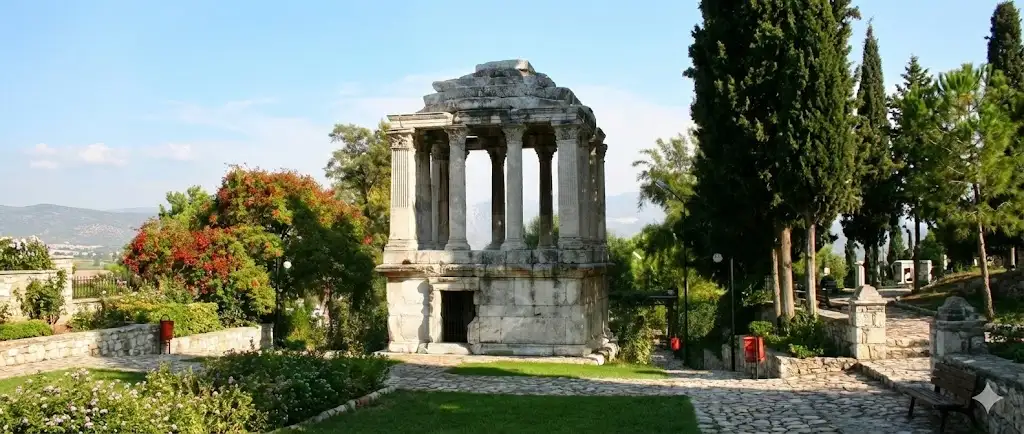
Gümüşkesen Monumental Tomb
One of the most impressive legacies of the Roman era, featuring elegantly crafted Sodra marble, a pyramidal roof, and unique architecture: The Gümüşkesen Monument. This masterpiece, surviving from the 1st century B.C. to the present day, opens the doors to the ancient world with its surrounding rock tombs and rich necropolis area.
In the Gümüşlük Neighborhood, between Mount Sodra and Hıdırlık Hill, there is a beautiful and interesting monumental tomb made of Sodra marble. Known locally as “Gümüşkesen,” this monumental tomb consists of a rectangular burial chamber and a pyramidal roof made of overlapping marble blocks, supported by piers and columns above this chamber. The monumental tomb rises on a two-stepped crepidoma. The entrance door to the burial chamber is in the west and is not exactly in the center but shifted slightly to the left. Inside the chamber, there are four piers supporting the floor of the upper story. Externally, the burial chamber forms a podium, in other words, a base, for the upper story. On the upper story, there are piers at the corners and two oval columns between the piers. The top two-thirds of the piers and columns are fluted. There are mortises showing that the spaces between the piers and columns up to the fluting were closed with marble balustrades. This is the reason why the columns are oval. The capitals are in the Corinthian order and carry a three-stepped low architrave and cornice. The capitals are decorated with two rows of palmettes and flutes behind these palmettes. The roof consists of five series of cross-laid beams placed one on top of the other, forming a false dome. It is thought that the ceiling, which is richly decorated with geometric shapes and relief plants and flowers, was painted when it was built. Both the proportions and the workmanship of the monumental tomb resemble Baltalı Kapı. Therefore, both must have been built in the same era, that is, at the end of the 1st century B.C., after the invasion of Labienus.
Starting from Gümüşkesen, numerous Roman-era tombs have been found on the slopes of Mount Sodra and Hıdırlık Hill. On the southern slopes of Hıdırlık, there are numerous underground rock tombs and burial chambers. These tombs are entered through a small landing reached by a few steps. The tombs are of various sizes and are surrounded on two or three sides by benches for placing bodies and votive offerings. In a few of them, there are small niches for placing oil lamps and gifts for the deceased. Most of the chamber tombs on the eastern slope of Mount Sodra and in the plain extending in front of it are vaulted-roof tombs. To the south of Esentepe and under the Özfen Science Prep School opposite the 2nd Gümüşkesen Mosque, roughly hewn marble sarcophagi placed side by side have also been found. There are also chamber tombs made with fine marble workmanship. One is in the garden of Gümüşkesen Primary School, and another is near the Industrial Market (Sanayi Çarşısı). In earlier years, one of these types of tombs was found in the garden of Milas Secondary School.
Historical Places (4)
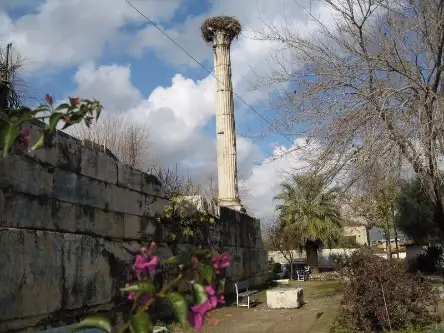
Uzunyuva Monumental Tomb
The monumental tomb of the Carian Satrap Hecatomnus, considered the "Discovery of the Century" in the world of archaeology. Dating back to the 4th century B.C., this site is the city's most important symbol with its famous column with a stork.
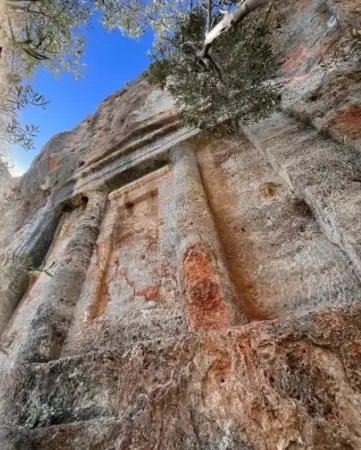
Berberini Monumental Tomb
Known locally as "Berberini," it is an impressive rock tomb carved into the cliffs behind the Milas city cemetery. The owner of the structure, which stands out with its elegant facade in the Doric order and nested burial chambers, is unknown.
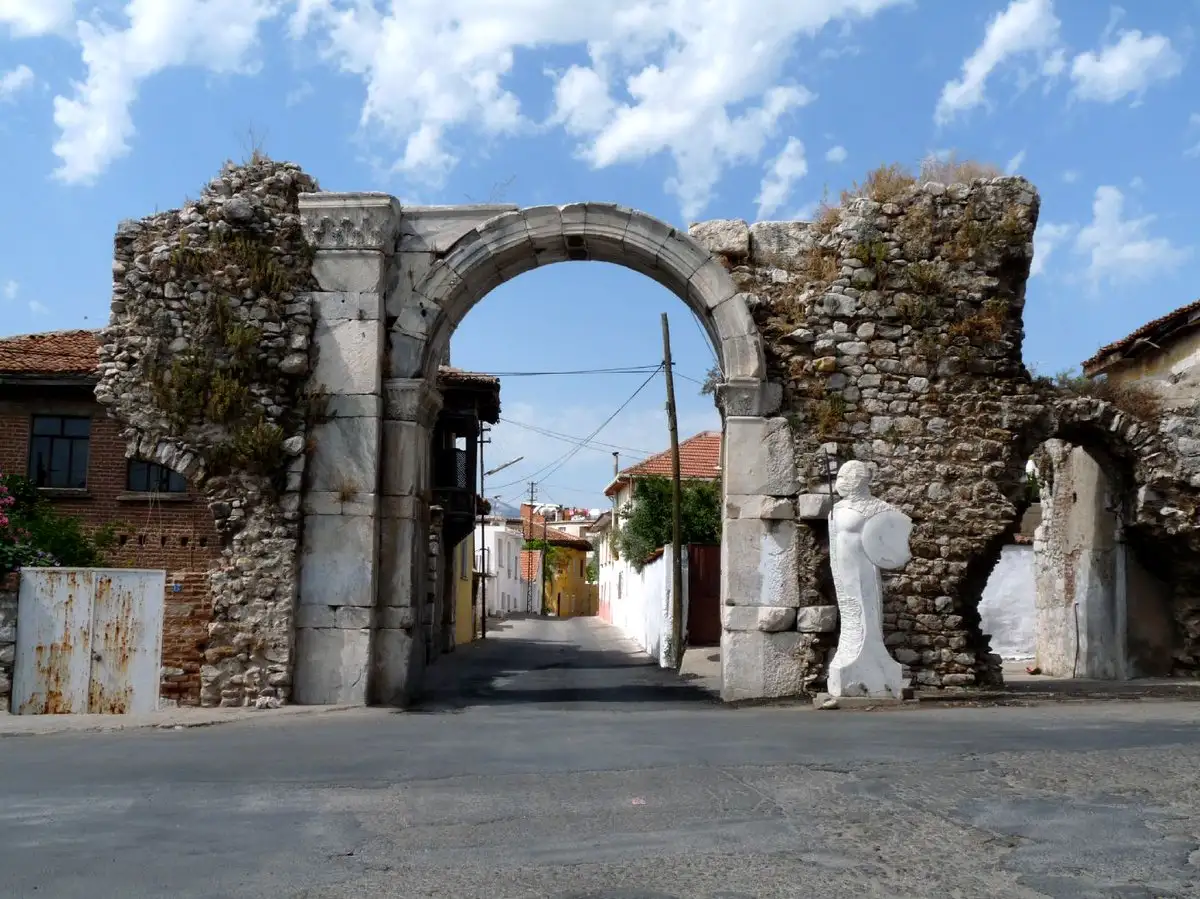
Baltali Gate
A magnificent monumental gate dating from the 1st century BC, marking the beginning of the marble-paved "sacred road" from Mylasa to Labranda. Named after the double-headed axe (Labrys) carved on its keystone, symbolizing Zeus.
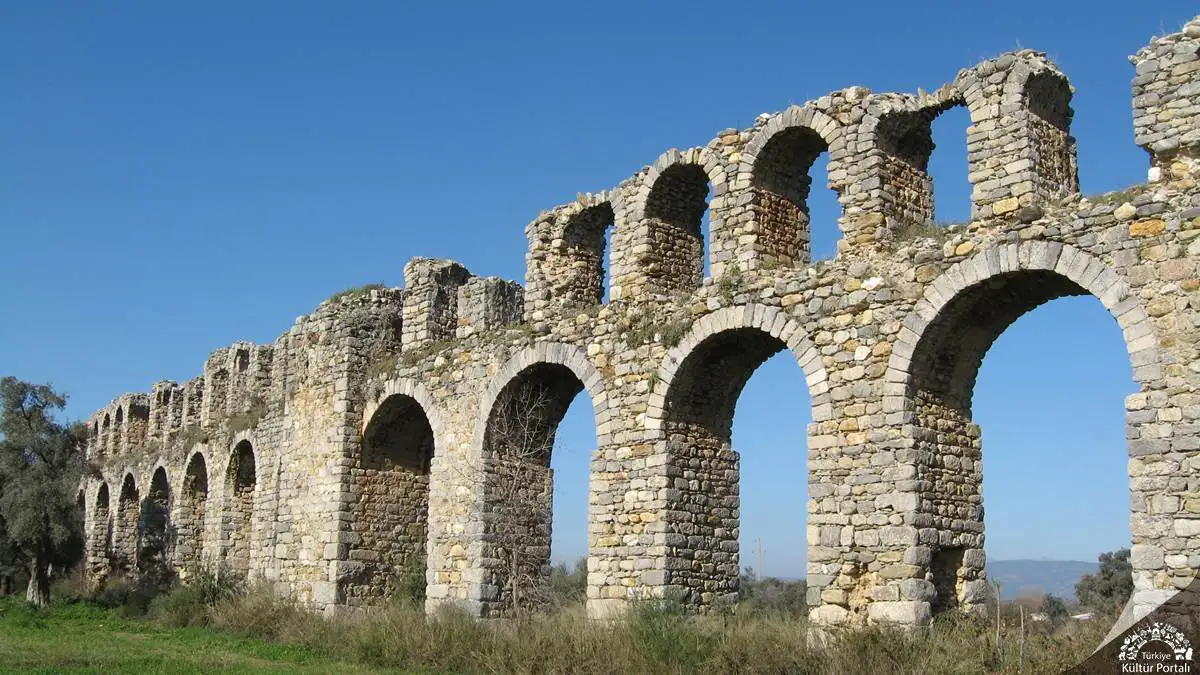
Aqueducts
A water channel with a double-tier arch system, built during the Roman Imperial period to bring water to the city from the mountains east of Milas. Ancient marble pieces were also used in its construction.

