
MILAS: THE LAND OF HISTORY, CULTURE AND ABUNDANCE
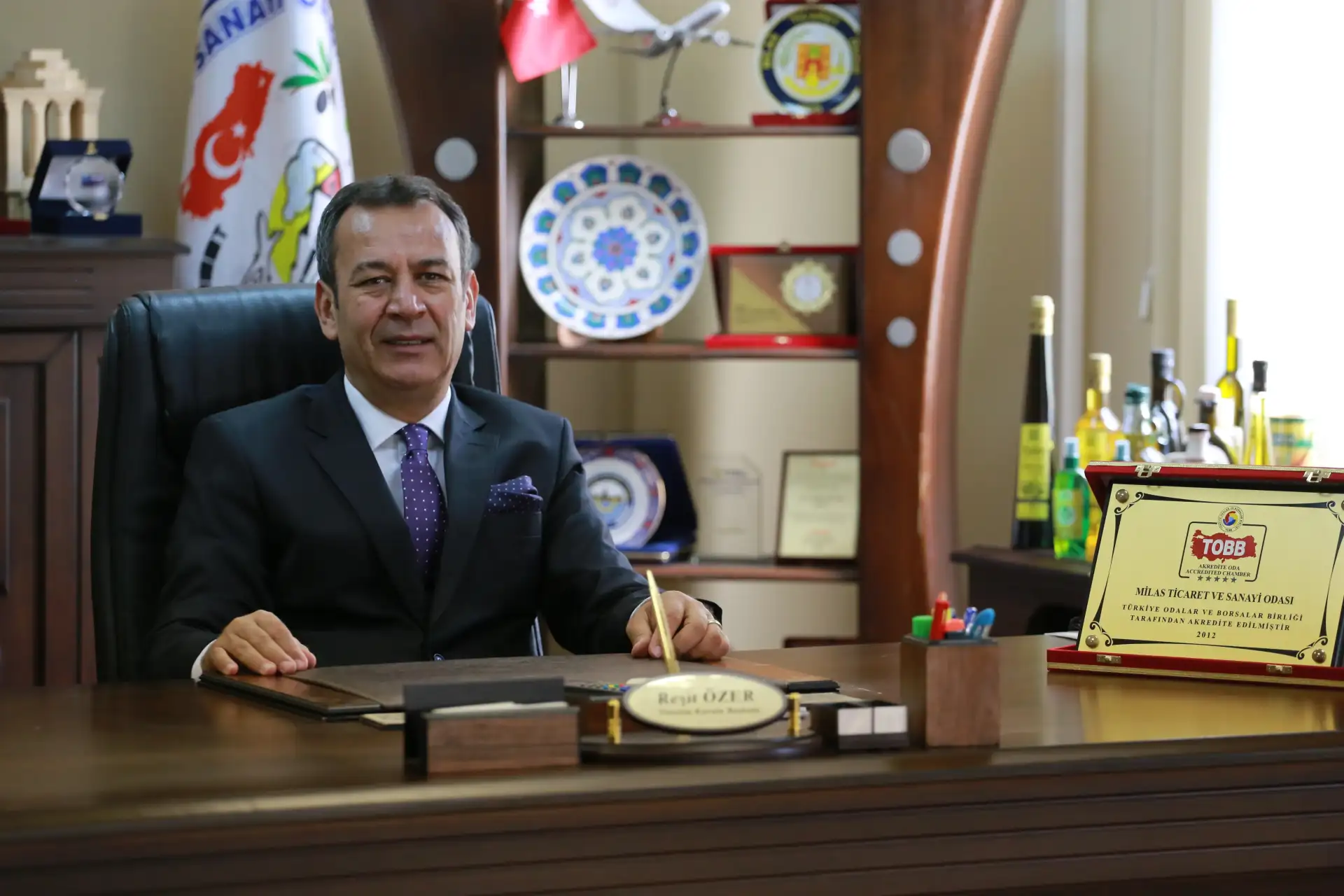
Chairman of the Board of Milas Chamber of Commerce and Industry, Reşit Özer
Milas is the last stop where roads intersect at the gateway of Southwestern Anatolia to the sea. Perhaps for this reason alone, it has been a town that has attracted human interest and the gaze of tribes for thousands of years.
Throughout history, a variety of products—from olives and olive oil to timber, tobacco, carpets, livestock, and honey—have been transported to the sea via Milas. In ancient times, these products were shipped from the port near Güllük, known as Passala, to the coasts of the Mediterranean.
Today, this process continues in a similar way. Although timber, live animals, leather, and carpet exports are no longer conducted, products such as emery stone, aluminum bauxite, feldspar, and marble extracted from the Milas region and the Çine and Aydın hinterlands are exported through Güllük port.
Milas is truly the meeting point of three roads: from Bafa Lake southwards, from Denizli, Tavas, Çine, Yatağan westwards, and from the fertile southern plains northwards.
Moreover, Milas is not just the last stop before reaching the sea—it is also a major attraction center due to its rich production capacity.
With its production power and the commercial potential built upon it, Milas has always been a center of interest. This attention has often led to invasions or migrations. Persians, Greeks, Alexander the Great and the Macedonians, the Rhodians, Romans, Byzantines, the Menteşe Beylik, Turks, later the Ottomans, and even the Italians following the Armistice of Mudros during World War I, all sought to seize and hold Milas.
Besides tribes and states, small communities or individuals seeking a new life, better living conditions, safety, and a more peaceful environment also migrated to Milas. This migration continues today, impacting both the population and the spatial growth of the town. Although migration brings urbanization, cultural interaction, and social challenges, it also contributes to the Milas economy.
The influx of people has undoubtedly boosted the housing sector. Thus, Milas has a vibrant construction industry.
However, the construction sector can only thrive in areas where production or trade generates resources. In this regard, Milas is fortunate.
When it comes to production in Milas, the first thing that comes to mind is undoubtedly olives and olive oil. Of Turkey’s 98,556,000 olive trees, 52,521,000 are in the Aegean region, 14,508,000 of which are in Muğla, and about 10 million of those are in Milas. In other words, Milas holds approximately 10% of Turkey’s olive trees. The products from these millions of olive trees are processed into olive oil in 83 factories. Olive oils obtained from Memecik olives are now entering the global market as brands. Currently, about 20 brands of Milas olive oil are offered to buyers in Turkey and worldwide. Among them are brands like that of esteemed olive oil producer Ali Osman Menteşe, which has won gold medals in competitions in Europe and the USA. Milas’s goal in olive cultivation is now to make its name known in table olive production as well. Efforts to introduce varieties such as Çekişke and Yağlı olives to world cuisine are increasing with awareness among locals. Olive cultivation, the backbone of Milas’ economy, remains a reliable economic pillar despite challenges such as low prices, insufficient domestic consumption, and marketing difficulties.
The sector increasingly joining olives in the Milas economy is aquaculture. 68% of Turkey’s farmed fish production takes place along Milas coasts. Additionally, Milas has a unique method of field aquaculture: ponds filled with low-salinity water extracted from underground in fields that have been salted and left out of production are used to raise sea bass and gilthead bream. These fish are processed, semi-processed, or frozen and exported to European countries. Aquaculture provides significant employment and substantial foreign exchange income to the region.
Milas is also an important carpet weaving center. Since the arrival of Turks in the 13th century, Milas carpets have been woven, attracting international buyers with their colors and patterns. In the 17th and 18th centuries, Milas carpets adorned European palaces and churches. Today, in villages such as Bozalan and Karacahisar, wool dyed with natural root and plant-based colors continues to be used. Patterns such as Adamilas, Bozalan Mihraplı, and Çıngıllıcafer are still woven and increase in value over time. Women and young girls use their spare time after working in olive, cotton, tobacco, or livestock production to weave Milas carpets, contributing to household, regional, and national economies.
Although not widely known, beekeeping and honey production are important sources of income for Milas villages. For some, they are the main, and for others, a supplementary source of livelihood. While Marmaris pine honey and Muğla honey are nationally known, Milas produces the most pine and flower honey in the province. Honey production significantly contributes to village economies.
Milas, famous in ancient times for Sodra marble behind the city of Mylasa, has once again become an important center for marble production and export. Milas marble is exported from Güllük port, providing significant employment and economic revenue.
Milas, known for its olives, olive oil, carpets, marble, fish, and honey, also has a lively agricultural and livestock sector. Traditional crops like tobacco and cotton, once a major part of Milas’ economy, have declined in recent years. However, vegetable and fruit production for tourism markets, as well as greenhouse farming, are increasingly widespread. Milk and dairy production have also seen notable growth recently.
With 1,124 kilometers of coastline, Muğla has the longest coastal stretch in Turkey. Milas, in turn, has the longest coastline in the province. Though not fully open to tourism, Milas coasts hold great potential for sun and sea tourism. Its real potential, however, lies in nature and cultural tourism. Milas offers significant historical tourism with its city center monuments and ancient cities such as Labranda, Beçin, Iasos, Euromos, Latmos / Herakleia, and Keramos. A few years ago, a monumental tomb believed to belong to the Persian Karia Satrap Hekatomnos, called "the discovery of the century in archaeology," was unearthed in Milas, adding immense value to its archaeological wealth. Once open, this site will be a highlight of Turkish archaeology.
In addition to historical monuments, Milas houses traditional Milas houses, its market, Çomakdağ houses and weddings, highland areas, hiking trails, and paragliding in Ören, all contributing to its cultural tourism.
Milas, with its production potential spanning agriculture, livestock, tourism, mining, carpet weaving, aquaculture, and honey production, not only sustains itself but contributes more to the national economy than it consumes.
The Milas Chamber of Commerce and Industry, with its organized network of business owners and industrialists supporting the local economy, reflects modern service quality, leads and guides the region, and provides grants and project support to improve production quality and exports, especially in aquaculture. Last year, it earned accreditation from TOBB and TSE, validating its service quality.
Our goal at MİTSO is to serve the region with a level befitting modern information and technological advancements, leveraging Milas’ rich historical and cultural heritage, and to provide new horizons to our members.
Reşit ÖZER
MILAS CHAMBER OF COMMERCE AND INDUSTRY
CHAIRMAN OF THE BOARD

