
MYLASA / MİLAS
Mylasa, the capital of Western Caria and the religious center of the ancient world, is home to a deep-rooted heritage extending from the foothills of Mount Sodra to the present day. Discover Milas's journey through thousands of years of history, tracing the footsteps of civilizations from the Persians to the Romans, and from the Menteşeids to the Republic.
Mylasa is the most important and largest city of western Caria. The suffix “-asa” seen in its name, common in ancient Anatolian geographical names, indicates that Mylasa has continued from a very old settlement. While the city was originally founded on the foothills of Mount Sodra and the hills in front of it, it expanded towards the plain over time.
Mylasa was located on the road descending from northeastern Caria to the sea. The temple of Zeus Karios, the national deity believed in by all Carians, was inside the city of Mylasa. The Temple of Zeus Labraundos, visited by people from all over Caria, and the Sanctuary of Sinuri were also very close to Mylasa. For this reason, Mylasa was virtually the religious center of Caria.
Mylasa was involved in the Ionian Revolt and the Persian Wars in the 5th century B.C. After the suppression of the Ionian uprising, Mylasa came under Persian rule again. After the Battle of the Eurymedon near Antalya Köprüçay in 446, Mylasa was freed from Persian rule. Between 450–440, it joined the Attic-Delian Maritime League. Mylasa, which initially paid 100 drachmas and later 4 obols to the league, came under Persian rule again after 440. Mylasa, ruled by satraps such as Hyssaldomos of Mylasa (appointed by the Persians), his son Hecatomnus, and his grandson Mausolus, remained the center of Caria until 360 B.C. At this date, Mausolus moved the administrative center from Mylasa to Halicarnassus.
Following the death of Mausolus and his wife/sister Artemisia, Mylasa was occupied by Alexander the Great. After Alexander's death and the fragmentation of the empire, it came under Seleucid rule in 230, gaining its independence again towards the end of the century. In 209/8 B.C., Mylasa signed an “isopoliteia treaty” with Miletus. Cities that made isopoliteia treaties granted mutual citizenship rights to each other. However, actually benefiting from this right was only possible by settling in the other city.
After the defeat of the Syrian King Antiochus III by the Romans, in the Peace of Apamea signed in 189 B.C., the land up to the Meander River was given to Rhodes. The treaty recorded that Mylasa was independent. After Rhodes lost its reputation in the eyes of Rome and was forced to withdraw from Caria, Mylasa first captured its neighbor Euromos, and then Hydai, Labraunda, Olymos, Chalketor, and Euromos individually made “isopoliteia” treaties with Mylasa and united politically. However, Euromos separated from Mylasa after a while and became independent again. The Sinuri Temple located in today's Kalınağıl village and the people living there also united politically with Mylasa during this time. Mylasa reached its widest borders in the 2nd century B.C. when it took the small neighboring cities under its sovereignty.
In 78 B.C., along with many other cities, Mylasa recognized the right of "asylia" (sanctuary) for the Temple of Hecate in Lagina and the festivals celebrated there. This right protected everyone taking refuge in the temple from attacks and violations during the festivals.
In 78/75 B.C., the Proconsul of Asia, Marcus Junius Silanus, made an official visit to Mylasa upon the invitation of a prominent Mylasa citizen, and the city gave the governor the honorary title of “Protector of the City.” In the middle of this century, Mylasa borrowed money from the representative in Ephesus of a great banker named Marcus Cluvius from Puteoli, Italy, and fell into a difficult situation regarding the repayment of this debt in 51. Also around these dates, Mylasa became a conventus center. Courts presided over by Roman governors were established in cities that were conventus centers. Until this time, there was only one conventus established in Alabanda in Caria.
During the Roman civil wars in 40 B.C., Hybreas, the head of Mylasa, followed a provocative policy against the Roman Labienus, who was advancing westwards crossing the Taurus Mountains at the head of the Parthian army, and incited the people of Mylasa to resist Labienus. However, the city surrendered after a brief resistance. Labienus placed a small garrison in the city. But later, when the people of Mylasa revolted against this garrison, the city was burned and destroyed, prisoners of war were killed, the people were put to the sword, fields were burned, and farms were plundered. The following year, when Labienus retreated south of the Taurus Mountains in the face of a strong army sent by Rome, Hybreas, who had fled to Rhodes before Mylasa surrendered, returned to his homeland and worked for the reconstruction of the ruined city. Later, Hybreas successfully opposed the Roman general Mark Antony's demand for a second tax from the cities of Asia.
Various coins, mostly copper, were minted in Mylasa. On the coins, there were mostly local gods and the double-headed axe and trident held by these gods, as well as animals they considered sacred such as horses, bulls, roe deer, eagles, and crabs. There was also a private bank in Mylasa that gained city privileges in the 3rd century A.D.
It is understood from the inscription “During the time of Hybreas as grammateus” written on coins minted between 17–12 B.C. to date them, that Hybreas was the grammateus, that is, the city secretary. In this period, the city secretaryship was an important civil service. Both Hybreas and Euthydemos were considered “heros,” that is, saints or in other words “heroes worthy of worship,” after their deaths.
After Labienus' invasion, Mylasa could not recover for a long time and had to borrow money from private individuals. After Augustus concluded the Roman civil wars in his favor, when he came to Samos in 31 to reorganize the eastern provinces, Mylasa sent a delegation to the emperor to explain the disaster the city suffered due to its resistance against Labienus. It is understood from a letter, part of which has survived to our time, that Augustus gave a positive response to this delegation. Probably, the construction of the “Augustus and Roma” temple in Mylasa was caused by Augustus' aid to the city. The cult of Augustus was accepted in Mylasa between 11 B.C. and 2 A.D. Only some wall fragments remain today from the Augustus and Roma temple. These walls can be seen in the basement of a house in the Hoca Bedrettin neighborhood. However, before the building was destroyed, it was seen and described by travelers Spon and Wheler in the 17th century and Pococke in the 18th century. This was a small temple with a podium, short proportions, with six columns in the front and back and seven on the sides. It had wide stairs in front and a deep gallery. The capitals on the facade side of the Ionic columns were also decorated with a row of acanthus leaves, and below these, there were four relief garlands encircling the entire column and large acanthus leaves on their bases. The frieze was decorated with ox heads, tripods, and pateras. The dedication inscription was written on the architrave on the facade: “ The People [dedicated this] to the Son of God, the Greatest Priest Emperor Caesar Augustus and the Goddess Roma.” There was a window in the middle of the pediment.
In 2–3 A.D., Mylasa gave the title of “Savior and Benefactor” to the Governor of the Province of Asia, C. Marcius Censorinus. Probably Censorinus helped the development of the city after the destruction of Labienus.
The inhabitants of Mylasa were divided into three “phyles” (tribes) named Otorkondeis, Hyarbesutai, and Konodorkondeis. Phyles were divided into demes, demes into syngeneias, and syngeneias into patras. The Otorkondeis phyle, about which we have much information due to inscriptions, had land, property, and officials. The decisions of the phyle were displayed in the temple of the phyle god. The temple also owned land. This land was managed and leased by officials called “God's proxies” elected by the phyle.
Byzantine Era
Mylasa lost its importance starting from the 4th century A.D. In the 5th century, there was a small Christian community in the city. Since Mylasa was not represented in the spiritual council (Council of Chalcedon) gathered in Chalcedon (Kadıköy, Istanbul) in 451, it becoming a bishopric center probably coincides with a date after this meeting. The names of eight bishops are known, three of whom lived in the second half of the 5th century and five in the 6th century. Ephrem, who is likely the first bishop, was buried in the small church in Leuko-kome (Şeyhköy near Yusufça). In the place of this church, there is now a ruined masjid and the tomb of Abdurrahman Effendi, the dervish of Şeyhköy, dated 1620 (Hijri 1030).
In the second half of the 5th century, during the bishopric of Kyrillos and Paulos, a saint named Xene, meaning “Stranger,” lived in Mylasa. A feast was held every January 24th in the name of Saint Xene. From Xene's life story, it is known that in the 5th century, there were two monasteries in the city, one being Hagia Andreas and the other the Monastery of Young Girls, and a small church in Leuko-kome. Bishop Paulos, who died shortly after Xene, was buried in the Hagia Andreas monastery where he had previously been the abbot. In the 6th century, Bishop Basileios repaired the Church of Protomartyr Stephen.
From the known life story of Saint Xene, we learn that in the 5th century in Milas, there were two monasteries within the city, one being Hagia Andreas and the other the young girls' monastery, and a small church in Leuko-kome. It is also thought that the Temple of Augustus and Roma was converted into a church during the Christian era. In addition to these, there is a fairly large church ruin decorated with frescoes and brick bands in the Kale location of Kırcağız village.
The aqueducts extending from Milas to the east of the city were built in the early Byzantine era. Plenty of ancient architectural pieces were also used in the construction of the aqueducts. Kuyruklu Hisar (Castle), located above Leuko-kome in what is known today as “Şeyhköyü,” was also rebuilt on old wall remains during this period. Mount Sodra, on the skirts of which Milas was founded and which was famous for its quality marble quarries in ancient times, was called “Hagia Elias” in the Christian era.
Turkish Era
In the early times of the Menteşeids (Menteşeoğulları), Milas became the center of the Menteşe Beylik. In the 14th century, Ibn Battuta describes Milas as “One of the most beautiful and largest cities of the land of Rum (Anatolia), with plenty of fruits, gardens, and waters.” This famous traveler stayed as a guest in an Ahi lodge where he received many treats and tells of meeting a zahid (ascetic) named “Baba esh-Shushteri,” who was said to be over 150 years old but vigorous and with a sound memory, having abandoned all positions, offices, and ranks to turn only to God. The tomb of Baba esh-Shushteri, whom the people of Milas showed great respect, was by the Balavca Creek. However, due to the changing of the creek bed to its current location and road arrangements, his grave remained under the road. A memorial stone was erected right next to it in the middle of the boulevard.
In Western sources, the name of Milas appeared as Milaso, Milasso, Melaso, Melasso, Mellassa, Milaxo, and Melaxo from the Middle Ages to the Modern Age. The current pronunciation of this name is Milâs, Meles, or Melas. Richard Pococke, who visited Milas in 1738–9, reports that the city was small and poorly built. At this time, the trade of Milas consisted of tobacco, cotton, and wax. There were thirty Greek families living in a separate inn (han) and using one of the inn rooms as a church. Armenians came to Milas to trade in some seasons and lived in a separate inn like the Greeks. (These inns must be the two inns where Persians resided in the Milas bazaar, which Abdülaziz Agha's son Mehmet Sait Agha counted among the properties he endowed to the Belen Mosque).
In the 18th century, an Agha was at the head of the administration in Milas. Richard Chandler, who came to Milas for archaeological research in 1764–5, describes his visit to the Agha as follows:
“The next morning we found the Aga, though very ill, with several of the Agas, playing at Jerid (Cirit), the national war sport, in the large court before his mansion. The beauty and tractability of the horses, which had very rich trappings, were as surprising as the agility and skill of the riders. With astonishing order, they galloped from all sides at once, throwing the jerid at each other, and snatching it from the ground with great dexterity. When one showed superiority, music struck up and shouts of applause filled the air. We waited under a portico with other spectators until the game was over. Then we were received in a large circle. The Aga was sitting cross-legged on the divan. The Mufti and a few others were sitting on his right. His retinue stood in a row, silent and respectful. The Aga was a handsome man with a black beard. We paid our respects in the customary manner by placing our right hand on our chest and bowing our heads. When we sat on the divan, we took out our firman. He kissed the firman, put it to his head, and handed it to be read. We were each served a chibouk (pipe), sweets, and coffee.”
The Agha's mansion, which was the scene of this visit, is on the plain between Hisarbaşı and Topbaşı hills; it is now in ruins and is called “Eski Konak” (Old Mansion). The Agha must be Hacı Mehmet Sait Agha, the son of Hacı Abdülaziz Agha, who is known for his foundations. Ömer Agha from this family held the title of “Kapıcıbaşı” (Head Doorkeeper) at the end of the 18th century and the beginning of the 19th century.
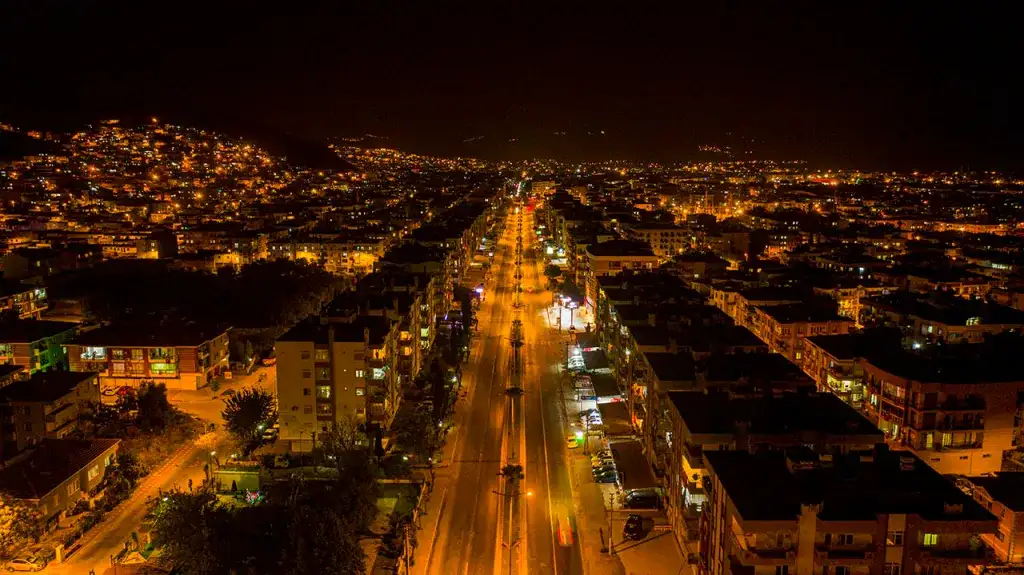
In Chandler's time, although Milas was quite large, its houses were not well built. The main crop seen in the fields was tobacco. Chandler writes that its air was bad and scorpions were plentiful. In Anton von Prokesch's visit in 1824–6, there were 1500 houses in Milas. In 1856, C.T. Newton describes Milas as a large town of beautiful appearance established on a wide plain.
Republican Era
Milas was occupied by Italians as a result of the Armistice of Mudros in the First World War. Following the War of Independence, with Turkey gaining its independence and the proclamation of the Republic, Milas became a district of the province of Muğla.
History of Milas (3)
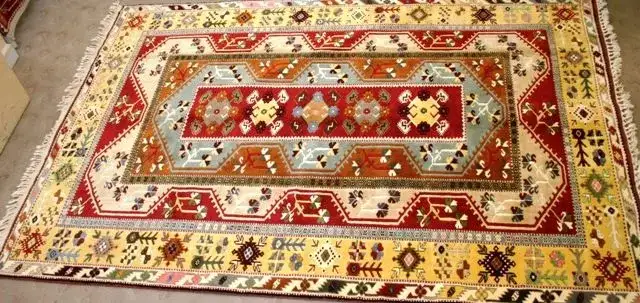
Milas Carpet
A traditional handicraft that developed with the settlement of Turks in the region from the 11th century and became an important export product during the Menteşe Principality period. Milas carpets are woven with 100% wool using the "Turkish knot" technique.
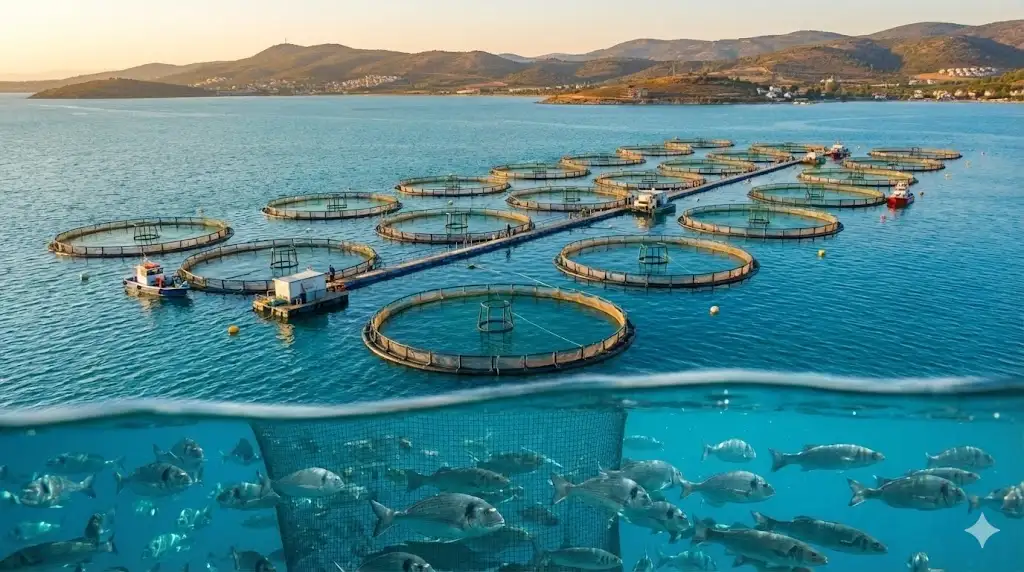
Fish Farming
Milas, where marine aquaculture first began in Turkey, is now the center of the most intensive production in Muğla. Production continues in floating systems at sea as well as land-based earth ponds.
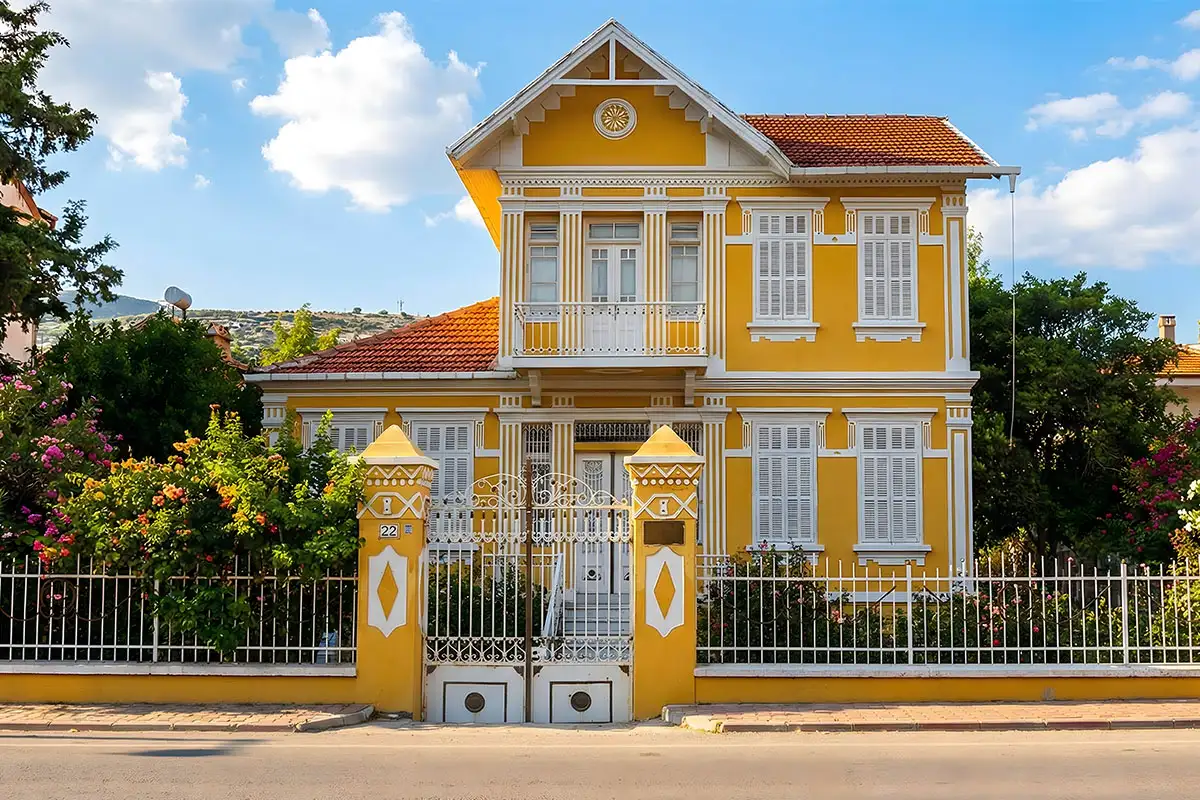
Historic Milas Houses
Distinguished examples of 19th-century civil architecture, Milas houses reflect typical Turkish house character with their courtyard plans, wooden-supported projections, and open halls called "önlük" (apron).

